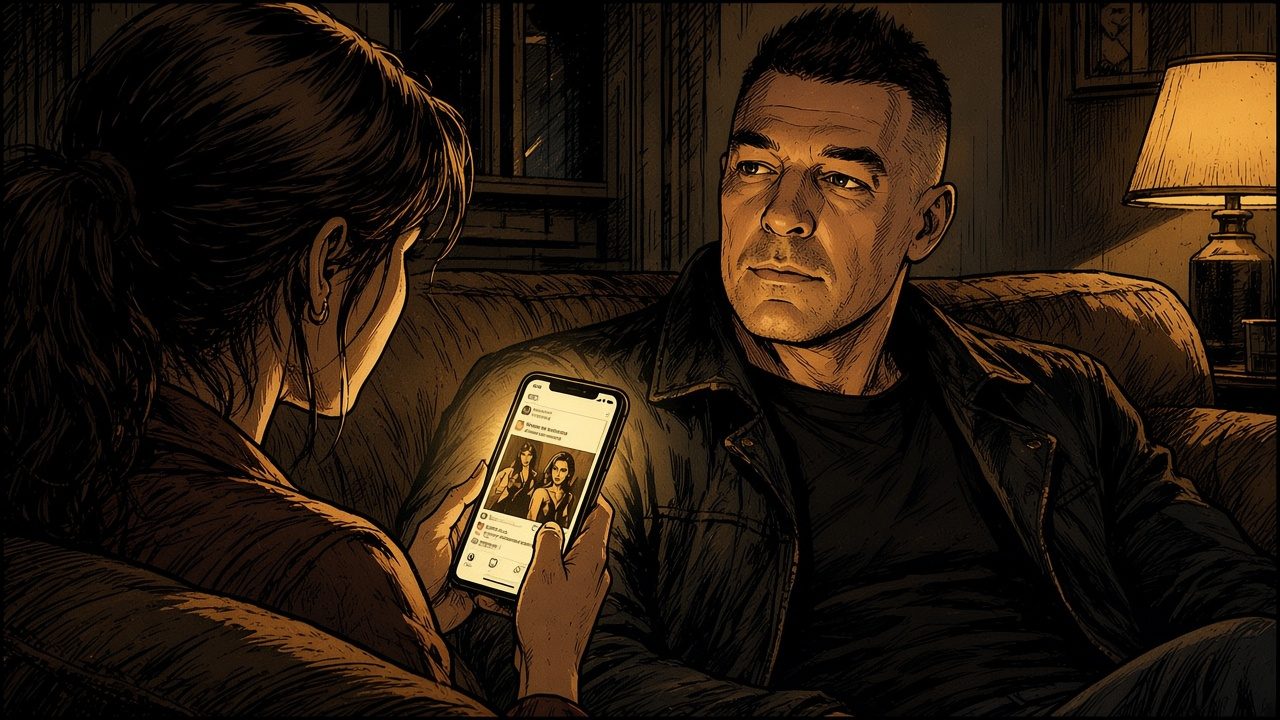
She has a man she used to enjoy being around. A home she was proud of. Friends, plans, things she worked for.
Then she opens Instagram.
Someone is in Italy. Someone just got engaged. A good-looking stranger is stepping out of a beautiful car. Another woman is being surprised with flowers in a hotel room. And suddenly her evening feels small.
Nobody insulted her. You didn’t do anything wrong. Nothing got worse in the last ten minutes. But her life feels less satisfying than it did before she picked up the phone.
Imagination isn’t the enemy. It’s part of romance; it’s how two people picture a future worth building. The problem starts when you feed it an endless supply of attractive strangers and beautiful moments. It builds a life nobody real can compete with.
Social media shows her a man’s best moments. Her imagination turns them into a better life.
And once that imaginary life becomes the standard, the real one starts losing. Here’s how that happens, step by step, and what you do about it as a man.
Watch the full video on YouTube.

1. Attention Becomes the Scoreboard
Start with the attention.
She posts a photo. Men compliment her. Her friends tell her she looks amazing. The numbers climb. Nothing strange about enjoying that. Being noticed feels good.
The trouble starts when the response stops being a pleasant extra and starts deciding how she feels about herself. She liked the picture when she posted it. Two hours later it hasn’t done as well as the last one, and now she’s wondering if she looks tired, if the outfit was wrong, if people are losing interest.
Her face didn’t change. The audience changed her opinion of it.
Rollo Tomassi describes attention as a kind of social currency. It doesn’t only mean a man wants her. It can mean she’s popular, admired, envied. That turns public approval into a position she feels she has to defend. So she checks again. Posts again. Picks the photo that gets the strongest reaction, even if it says less about who she actually is.
The attention stops being something she enjoys and becomes something she needs to feel enough.
And attention does one more thing. It doesn’t just tell her she’s attractive. It tells her that somewhere, there’s always another option.

2. Being Noticed Is Not Being Chosen
Look at an Instagram inbox. Compliments. Reactions to Stories. Little invitations. One guy who keeps finding reasons to start a conversation.
She doesn’t have to want any of them. Most mean nothing to her. But taken together they create an impression: I have choices. If this doesn’t work out, there’s something else.
Now make one of those men especially impressive. He looks successful. He travels. He seems confident. Every so often he reacts to her Story.
What does she actually know about him? That he noticed her. That’s it. She doesn’t know if he’s single, if he wants a relationship, whether they’d get along, or whether he sends the same fire emoji to thirty other women.
But that tiny signal starts carrying a much bigger meaning. Maybe this is the kind of man I could be with. Maybe I’ve been settling. Now a man who has committed nothing is setting the standard for the man who committed everything.
Men need to get this straight. Interest is not investment. Sexual interest is not a shared future. A crowded inbox tells you nothing about who will still be there when life gets inconvenient.
A message tells her he noticed. It doesn’t tell her what he’d build with her.

3. The Picture Doesn’t Contain the Whole Man
A man stands on a balcony overlooking the sea. Well dressed. Relaxed. Beautiful light.
What does that photo prove? That he stood on that balcony when it was taken. It doesn’t tell her how he handles an argument, whether he listens, whether he keeps his word, or whether he’s generous with anything besides photos of himself.
Her imagination fills that in. He travels, so he must be adventurous. He has a business, so he must be capable. He looks calm, so being with him must feel safe.
Maybe. Maybe not. The picture hasn’t answered the question.
Rollo makes a useful point here: unfamiliarity leaves blanks, and those blanks get filled with whatever qualities a woman hopes to find. So she isn’t just looking at a stranger anymore. She’s picturing dinner with him. A holiday. The version of herself she’d be beside him: more relaxed, more desired, more alive.
Notice who’s doing the work here. The photo is just a starting point. Her hopes supply the chemistry and the way he’d treat her, and suddenly a different man means a different version of her whole life.
The missing information doesn’t weaken the fantasy. Sometimes it’s what makes the fantasy possible.

4. He Has Blanks. You Have Flaws She Already Knows.
Now put that fantasy next to you.
She knows your habits. She knows you go quiet when you’re tired. She knows your bad jokes and your Sunday-morning sweatpants. She’s seen you stressed about money. She’s seen you get something wrong and struggle to admit it.
The guy on her screen never had to go through any of that in front of her. He gets to show up as pure possibility. You show up as a complete human being.
The man beside her has flaws she knows. The man on her screen has blanks she can fill with whatever she wants.
You come home wrecked, eat, and fall asleep early. Then she sees a stranger’s Story from a rooftop restaurant. Suddenly being with him looks exciting, and being with you looks like this one tired Tuesday.
But she’s comparing his best selected moment with full, everyday access to you. She hasn’t seen rooftop guy in traffic. His boring work calls. The weeks when nothing happens. She’s never had to ask him to show up for anything.
This is where familiarity works against appreciation. Your good qualities become expected. Your limitations stay visible.
Being dependable doesn’t entitle you to a relationship; attraction and compatibility matter. But an untested fantasy is not evidence that the real relationship is a mistake. If every ordinary evening gets measured against somebody else’s highlight reel, ordinary starts to feel like failure.

5. She’s Competing With a Woman Who Doesn’t Exist
The comparison doesn’t stop at men. Look at the women in her feed.
One has the body. Another has the house. Another has the career. Another seems to travel whenever she feels like it. One shows a beautiful marriage. Another shows the freedom of being single.
Stitch those together and you’ve created a woman who doesn’t exist. She has the security of a settled life and the freedom of no responsibilities. A demanding career and unlimited free time. A beautiful home that somehow never needs cleaning.
Nobody claims that’s realistic, but seeing the pieces daily makes her own trade-offs feel disappointing.
Rollo’s idea of the global sexual marketplace explains the wider setting. The comparison isn’t limited to the people she actually knows anymore. Her phone can keep supplying someone hotter, richer, better dressed, somewhere more beautiful. And imagination supplies the feeling behind each picture: that house must feel peaceful, that marriage must feel romantic, that woman must wake up confident every morning.
She’s comparing one complete life with the best pieces of a thousand others.
The picture of freedom doesn’t show what that single woman misses about having a partner. The picture of family life doesn’t show what that mother gave up. A feed shows the rewards of opposite choices without showing either set of costs.
That’s a race with no finish line. She gets the holiday and sees a better holiday. She improves her looks and finds another woman to compare herself to. When the target keeps moving, getting more doesn’t bring her any closer to satisfied.

6. Browsing Starts Replacing Building
Here’s where the comparison stops being in her head and starts changing her actual life.
She feels disappointed, so she opens Instagram for a break. Finds a more exciting possibility. Spends time imagining it. Comes back to her own evening feeling further away from it.
That attention has to come from somewhere. Maybe the two of you could have planned a weekend away. Instead you sit side by side while she watches other people travel. Maybe one honest conversation would have cleared up a misunderstanding. Instead she keeps replaying the thought that someone else would just understand her without all this effort.
The imagined relationship never needs repairs. The real one does. So the fantasy gets her excitement, and you get whatever is left of her patience.
Over time you share less. Make fewer plans. Get less curious about each other. Now the relationship really does feel flat, and she takes that as proof she was right all along: this life isn’t enough.
But part of what weakened it was attention being pulled away from it.
The more time she spends imagining another life, the less attention she gives the one that could actually get better.
This isn’t an argument for staying in a bad relationship. It’s a question of whether a good one is getting a fair chance. You can’t find out what two people can build when one of them is always mentally somewhere else.

7. Applause Is Not Advice
Once she’s disappointed, the phone has one more thing to offer: an audience ready to agree.
She vents to the group chat, or posts a Story about knowing her worth. The replies roll in. You deserve better. Never settle. The right man wouldn’t make you feel like this.
Sometimes she does deserve better. Sometimes leaving is the right call. But the people cheering her on know one angry paragraph about a relationship that has lasted years. They don’t know what happened before the argument, what she said, or whether this is a real pattern or two exhausted people handling a bad evening badly.
Rollo has written about social media handing out instant affirmation for grievances. What matters is what that affirmation replaces. A real friend asks hard questions. What actually happened? Did you tell him what bothered you? Is this relationship wrong, or are you expecting him to match something nobody can keep up?
Automatic agreement asks nothing. It gives instant relief and leaves the real problem untouched.
Feeling supported can help you move forward. Being told you’re right every time keeps you exactly where you are.
Imagination can work the other way too: picturing what you could build with a bit more effort, and remembering that familiar kindness is still kindness.

8. Don’t Compete With a Fantasy
So what do you do with all this as a man?
Stop trying to beat an entire feed. You can’t keep buying bigger experiences to outdo somebody else’s best photo. That contest eats every dollar and ounce of energy you throw at it.
Watch for reciprocity. Does she enjoy being with you when there’s nothing impressive to post? Does she notice your effort? Can she raise a problem without treating the whole relationship as a letdown? Does she help create the life she says she wants? You want a partner, not a permanent audience member waiting for you to produce the next exciting scene.
You can’t negotiate desire. Rollo’s principle holds here. Spending more, re-explaining your value, pleading for appreciation: none of it makes someone genuinely want the relationship.
Talk, but don’t police. Talk about your time together. Set boundaries. Say plainly when the phone keeps winning. But don’t become her phone inspector. You can’t monitor someone into wanting to be present.
Don’t confuse dependable with passive. Keep your interests, your friends, your health and your curiosity. Bring a life to the relationship instead of making the relationship your whole life.
Hold yourself to the same standard. Don’t demand her presence while you spend every night scrolling through other women.
Here’s the simple tell. One woman says, “Let’s do something different this weekend,” and helps make it happen. Another says, “We never do anything,” then shoots down every ordinary plan because it doesn’t look like the picture in her head. The first is inviting you to build. The second is asking you to compete.
You don’t need to beat every man on her screen. You need a relationship where both people choose to be present.
Give Your Real Life a Fair Chance
Social media can offer attention without closeness, possibilities without commitment and beautiful pictures without the reality behind them. Imagination connects the pieces, and suddenly a stranger becomes a better partner, a holiday becomes a better life, and a quiet evening becomes evidence that something is wrong.
That’s how more keeps producing less satisfaction.
The answer isn’t to stop imagining a better life. It’s to stop confusing an attractive picture with proof that somebody else is living it. Choose a woman who can appreciate a good life while helping you make it better, and be that kind of partner yourself.
A good life needs imagination. But it also needs your attention.
Stay sovereign.
Affiliate disclosure: Some links in this article are affiliate links. If you buy through them, I may earn a small commission at no extra cost to you. I only recommend things I'd use myself.