
Most men want to be good. Fewer are prepared for the fact that being good, on its own, doesn’t protect you.
You can work hard and still lose your job to a man who played the politics better. You can be generous and find that people take more than they give back. You can trust a partner, a client or a friend and learn too late that they were never what they seemed. Then you face a choice. Some men harden and decide to become as ruthless as the people who hurt them. Others stay soft, and keep getting hurt.
Niccolò Machiavelli’s The Prince offers a third path, if you read it carefully. It’s a short, cold-eyed book about how power is won, kept and lost. It doesn’t pretend the world is kinder than it is. Read well, it teaches you to see clearly, to rely on yourself, to prepare in calm times for the storm, and to act decisively when the moment comes. That’s leadership, and before it leads anyone else, it’s self-rule.
This post is about reading it that way.
What the Book Is
Machiavelli was a Florentine civil servant and diplomat. From 1498 to 1512 he served the Florentine Republic, travelling on missions to the king of France, the pope, the emperor, and to Cesare Borgia, the son of Pope Alexander VI, who was carving out a state for himself in central Italy. Machiavelli watched Borgia closely, and Borgia became one of the main case studies in the book.
In 1512 the Republic fell, and the Medici family returned to power in Florence with Spanish help. Machiavelli lost his post. Early in 1513 he was accused of taking part in a conspiracy against the Medici, imprisoned and tortured, then released in a general amnesty. He retired to his small farm outside Florence, at Sant’Andrea in Percussina.
It was there, in 1513, that he wrote The Prince. In a famous letter to his friend Francesco Vettori, he described spending his days on ordinary farm business and his evenings in his study, changing into formal clothes to “converse” with the great men of antiquity through their books. The Prince came out of those evenings. He dedicated it to Lorenzo de’ Medici, hoping to return to public service. It didn’t work. The book circulated in manuscript and was published in 1532, five years after his death.
It’s short: twenty-six brief chapters. The first part covers different kinds of states and how they’re won and held. The middle covers armies and the need for your own forces. The most famous part, roughly chapters 15 to 23, covers how a ruler should behave. The last chapters deal with fortune, and end with an appeal to free Italy from foreign armies.
Why It’s Controversial
Machiavelli’s name became an insult almost immediately. The Catholic Church put his works on its Index of prohibited books in 1559, and “Machiavellian” came to mean cunning, deceitful and amoral. Psychologists today use “Machiavellianism” as the name for a manipulative personality trait.
There’s a reason for the reputation. Machiavelli says plainly that a ruler who tries to be good in every situation will be ruined among so many people who are not good, and so must learn how not to be good, and use that knowledge as necessity demands (my paraphrase of Chapter 15). He praises Cesare Borgia’s ruthlessness. He says it’s safer to be feared than loved if you can’t be both.
But “Machiavellian,” as commonly used, is a misreading. Three things get lost:
- He was describing, not cheering. His stated aim was to write about how things actually are rather than how people imagine they should be. Much of the book is a warning about what happens to rulers who are naive.
- He drew lines. He says outright that crimes like those of Agathocles, who seized Syracuse by murdering its leading citizens, can win power but not glory. He insists a ruler must avoid being hated, must not take his people’s property or their women, and must build on the goodwill of ordinary people.
- “The ends justify the means” isn’t in the book. The closest he comes is observing that people judge rulers by results. That’s a hard truth about how others see you, not a licence.
He also wrote the longer Discourses on Livy, which argues for republics. The Prince is a manual for one brutal situation: a new ruler holding a fragile state in sixteenth-century Italy.

How to Read It: Self-Rule First
You’re not a Renaissance prince. You don’t have an army, a state or enemies plotting to poison you. So the most useful way to read the book is in two layers:
- Rule of the self. Most of Machiavelli’s advice works as advice for governing your own life: prepare before the storm, rely on your own skills, keep your word to yourself, don’t be ruled by flatterers, act decisively. This layer is almost always healthy.
- Rule over others. Leading a team, running a business, negotiating with a hard counterpart. Here some of his advice is wise and some needs a firm ethical filter.
A simple test before using any tactic on another person: would I be comfortable if they knew exactly what I was doing and why? If yes, it’s leadership. If no, it’s manipulation, and in love or friendship it will cost you more than it gains.
This fits the idea behind HRH: SOVEREIGN. The word itself means a ruler. A sovereign man governs his own life first: his time, his habits, his word, his frame. He doesn’t need to rule anyone else to feel secure, and he doesn’t hand his rule to anyone who reaches for it.
Who This Article Is For
This is for you if:
- You lead people, or want to: a team, a business, a family, a group of friends.
- You’re building a business or career and need to understand how power, loyalty and reputation actually work.
- You’re too trusting, or too eager to be liked, and it’s cost you.
- You’ve hardened after being hurt and want a way to be strong without becoming cold.
- You’ve heard the word “Machiavellian” and want to know what the book actually says.
I’ve built an online business and lived in six countries, which means I’ve had to rely on myself in a lot of unfamiliar places, often with no one to fall back on. That’s the part of Machiavelli I find most useful, and it’s where this post puts its weight.
How to Use This Article
Read it by theme. I’ve grouped the book’s key lessons into nine themes. For each you’ll find the lesson in plain language, how it applies at work, in business, in dating and relationships, and in daily life, where the ethical line is, and two exercises.
Start with self-rule. For the first few weeks, apply the lessons to yourself before you apply them to anyone else.
Separate the court from the home. Machiavelli wrote about states and armies. A relationship is neither. There’s a section below on what to drop at the front door.
Read the companion. This pairs naturally with my article on Robert Greene’s The 48 Laws of Power . Greene drew heavily on Machiavelli, and the two read well side by side. Greene is a catalogue of tactics; Machiavelli is the deeper source, more focused on leadership, foundations and the role of fortune.
Contents
- The Prince at a Glance
- Theme 1: Virtù and Fortuna – Build Your Dykes in Calm Weather
- Theme 2: Rely on Your Own Arms
- Theme 3: Loved or Feared – and Never Hated or Despised
- Theme 4: Appearing and Being – the Fox and the Lion
- Theme 5: Hard Things at Once, Generosity with Care
- Theme 6: Choosing Advisors and Avoiding Flatterers
- Theme 7: Acquiring and Keeping – Build on Solid Foundations
- Theme 8: Study Great Men and Prepare in Peace
- Theme 9: Decide – Avoid Neutrality and Half-Measures
- What to Reject or Use with Caution in Relationships
- How to Use This: A 30-Day Practice and Checklists
The Prince at a Glance
| Chapters | The core idea, in plain language |
|---|---|
| 1–2 | States are either inherited or new. Inherited ones are easy to keep; new ones are hard. |
| 3 | When you gain something new, live there or stay close to it, and correct problems early, before they grow. |
| 5 | People who are used to freedom don’t forget it. Win them over or expect resistance. |
| 6 | The greatest founders (Moses, Cyrus, Romulus, Theseus) rose through their own ability and their own forces. Unarmed prophets fail. |
| 7 | Power gained through other people’s help and good luck is fragile. Cesare Borgia shows both the skill and the limits. |
| 8 | Power can be seized by crime, but crime brings no glory. If harsh measures are necessary, do them at once and don’t repeat them. |
| 9 | Build on the goodwill of ordinary people rather than relying on a few powerful backers. |
| 10 | Measure your real strength: can you stand on your own when trouble comes? |
| 12–13 | Hired and borrowed forces are unreliable and dangerous. Build your own. |
| 14 | A leader must keep studying and training, in peace as much as in war, and learn from great men in history. |
| 15 | Deal with the world as it is, not as you wish it were. |
| 16 | Showy generosity drains you. Prudent thrift often serves people better. |
| 17 | Better to be both loved and feared; if you must choose, being feared is safer, but never be hated. |
| 18 | Combine the fox (seeing traps) and the lion (strength). Appearances matter. |
| 19 | Above all, avoid being hated or held in contempt. |
| 20 | The best fortress is not being hated by your people. |
| 21 | Earn respect through great undertakings, and take sides rather than staying neutral. |
| 22–23 | Choose capable advisors, and invite the truth from them on your own terms. Avoid flatterers. |
| 24 | Rulers who lose their states usually blame fortune, when the real cause was their own lack of preparation. |
| 25 | Fortune controls perhaps half of what happens. The rest is yours to shape. |
| 26 | A call to action: the moment is ripe; seize it. |

Theme 1: Virtù and Fortuna – Build Your Dykes in Calm Weather
The lesson in plain language. Two words run through the whole book. Fortuna is fortune: luck, chance, circumstances, the things that happen to you. Virtù doesn’t mean virtue in the moral sense. It’s closer to ability, skill, energy, courage and the capacity to act effectively. Machiavelli’s question is how much of life is fortune and how much is up to us.
His answer, in Chapter 25, is that fortune may govern about half of what happens, but leaves the other half to us. He compares fortune to a violent river that floods, tears up trees and sweeps away buildings. Nothing can stop it once it’s raging. But in calm weather, men can build dykes and embankments, so that when the river rises it either stays in its channel or does far less damage. Fortune shows its power where no ability has been organised to resist it.
He adds another point that’s easy to miss: people get ruined when the times change and they don’t. A cautious man succeeds in cautious times and fails when boldness is needed; a bold man the reverse. Few people can change their nature to suit the times. He ends the chapter with a famous image of fortune as a woman who favours the bold, an image that’s dated and that I’d leave in 1513. The useful point inside it is that in uncertain times, boldness usually beats excessive caution.
At work. Build skills, savings and relationships when things are going well, not when the layoffs are announced. Keep your CV current and your network warm even when you’re happy in your role.
In business. Your dykes are an emergency fund, more than one income stream, documented processes and loyal customers. Build them during the good months. Notice when the market changes, and change with it rather than repeating what used to work.
In dating and relationships. You can’t control whether you meet the right person, or whether a relationship survives every storm. You can control whether you’re a man worth being with: healthy, stable, with your own purpose and friends. Those are your dykes. Build them before you need them, not after a breakup.
In daily life. Health, sleep, money and friendships are all built in calm weather.
The ethical line. This theme is almost entirely healthy. The only trap is the opposite mistake: assuming everything is in your control and blaming yourself for every flood. Machiavelli is clear that half of it isn’t. Take responsibility for your half.
Exercises.
- List the three floods most likely to hit you in the next year: a job loss, a health problem, a breakup, a market change. For each, write one dyke you can start building this month.
- Write down one way you operate that worked well in the past but may not suit the times now. Decide one small change.

Theme 2: Rely on Your Own Arms
The lesson in plain language. Machiavelli spends three chapters (12 to 14) on armies, and his conclusion is blunt. Mercenaries, soldiers hired for money, are useless and dangerous. They’re brave among friends and cowardly before enemies, and they have no reason to die for you. Auxiliaries, troops borrowed from a powerful ally, are even worse: if they lose, you’re defeated, and if they win, you’re in their debt. He blamed Italy’s collapse in his own time on its reliance on hired armies.
Cesare Borgia, he notes, began with French auxiliaries, moved to mercenaries, and only became strong once he built forces of his own. Machiavelli also uses the story of David, who refused Saul’s armour before facing Goliath and fought with his own sling instead. Another man’s armour either falls off you, weighs you down or binds you.
The founders he admires most in Chapter 6 (Moses, Cyrus, Romulus and Theseus) owed little to fortune beyond the opportunity. Everything else came from their own ability. He contrasts them with Savonarola, the Florentine friar who briefly dominated the city and fell as soon as people stopped believing in him, because he had no force of his own to fall back on. Armed prophets succeed; unarmed ones fail.
At work. Your “own arms” are your skills, your reputation and your results. Don’t rely entirely on one boss’s favour or one company’s loyalty. Build abilities that go with you wherever you go.
In business. Don’t let your business depend on one platform, one big client or one partner who could walk away. A business built on borrowed strength belongs to whoever lent it.
In dating and relationships. Your own arms are your own life: your income, your friends, your purpose, your sense of who you are. A man who has these is with a woman because he wants to be, not because he needs her to hold him up. That makes him a better partner, not a colder one.
In daily life. Learn to do things yourself: cook, fix things, manage your money, navigate a new city. Self-reliance is quiet confidence.
The ethical line. Self-reliance is healthy. Its corrupted form is refusing all help and all dependence, which leaves you isolated and proud. Machiavelli wasn’t against allies; he was against depending on forces you don’t control. Have allies. Don’t let them be your only defence.
Exercises.
- List what your income, your social life and your sense of worth currently depend on. Mark anything that’s “borrowed armour,” held up by someone else. Pick one to strengthen with your own arms.
- Learn one practical skill this month that you’d normally pay or rely on someone else for.

Theme 3: Loved or Feared – and Never Hated or Despised
The lesson in plain language. Chapter 17 asks the most famous question in the book: is it better to be loved or feared? Machiavelli’s answer is that it’s best to be both, but since that’s hard, if you must choose, it’s safer to be feared. His reasoning is cold: people are often fickle and self-interested, and love is a bond they’ll break when it suits them, while fear of punishment holds more reliably.
But he immediately adds the crucial condition: a ruler must be feared in a way that avoids hatred. And the way to avoid hatred is simple: don’t take people’s property and don’t take their women. He observes, sharply, that people forget the death of a father sooner than the loss of their inheritance (a paraphrase). He contrasts the Carthaginian general Hannibal, whose harshness kept a huge army of many nations united without mutiny in foreign lands, with the Roman general Scipio, whose excessive leniency led his troops to mutiny in Spain.
Chapters 19 and 20 extend the point. A ruler must above all avoid being hated or held in contempt. Contempt comes from seeming changeable, frivolous, soft, cowardly or indecisive. And he concludes that the best fortress a ruler can have is not to be hated by his people.
At work. Translate “feared” as “respected”: people know you have standards and will enforce them. A manager who’s only liked gets walked over; one who’s only feared gets quietly sabotaged. Be fair, consistent and clear about consequences, and never humiliate people or take what’s theirs: their credit, their time, their dignity.
In business. Clients and staff should know your boundaries: payment terms, quality standards, how you handle broken agreements. Enforce them calmly and consistently. Avoid contempt by being decisive and steady; nothing kills respect faster than a leader who changes his mind every week.
In dating and relationships. Here the lesson must be translated carefully. A partner should never fear you. That’s not a relationship; it’s a threat. What does carry over is the warning against contempt. Women, like anyone, lose respect for a man who’s indecisive, needy, inconsistent or unable to hold a boundary. Be loved, and be respected. The respect comes from having standards and keeping them, not from making anyone afraid.
In daily life. Be a man whose word holds and whose boundaries are known. That’s the healthy core of “feared.”
The ethical line. Respect built on fairness and firm boundaries is healthy everywhere. Fear built on threats, anger or punishment is corrosive in any personal relationship, and short-sighted at work: it breeds the hatred Machiavelli warned against. With people you love, choose love and respect, never fear.
Exercises.
- Write down three boundaries you hold (or want to hold) at work and at home. For each, write calmly how you’ll respond when it’s crossed. Then keep them for a month.
- Ask yourself honestly where you might be drifting into contempt: indecision, inconsistency, complaining, neediness. Pick one and work on it this week.

Theme 4: Appearing and Being – the Fox and the Lion
The lesson in plain language. Chapter 18 is the darkest in the book, and the most quoted. Machiavelli says there are two ways of fighting: by law, which is proper to men, and by force, which is proper to beasts. Since the first often isn’t enough, a ruler must know how to use the second. Of the beasts, he should imitate the fox and the lion. The lion can’t defend itself from traps, and the fox can’t defend itself from wolves. So you need to be a fox to recognise traps and a lion to frighten off wolves. Those who rely only on the lion don’t understand this.
He goes further: a wise ruler can’t keep his word when keeping it works against him and the reasons for giving it have gone. People, he says, judge mostly by appearances and results, because everyone can see what you seem to be but few can touch what you really are. A ruler should appear merciful, faithful, humane, honest and religious, and be so when he can, but be able to act otherwise when necessary.
At work. The fox is the part of you that sees office politics clearly: who’s taking credit, who’s building a case, which meeting is really a trap. The lion is the part that stands up calmly when you need to: declines unreasonable demands, holds your ground in a negotiation. Most nice men have neither. Develop both.
In business. Read contracts like a fox; look for the clause that hurts you. Defend your interests like a lion. And understand that appearances count: a professional website, a well-run meeting and a calm demeanour send signals before you’ve proved anything.
In dating and relationships. The fox is valuable for spotting manipulation: someone who’s hot and cold, who pushes you to commit too fast, who isolates you from friends. The lion is valuable for holding a boundary calmly. What doesn’t belong in a relationship is Machiavelli’s permission to break your word or to seem good while being otherwise. That’s lying, and intimacy can’t survive it.
In daily life. Be a fox with your money and your data. Be a lion about your health, your time and your values.
The ethical line. Seeing traps (the fox) and having the strength to defend yourself (the lion) are healthy and necessary. Breaking your word and maintaining a false front are corrosive in personal life, and in business they eventually destroy the reputation you depend on. My rule: be what you appear to be. The fox is for seeing, not for deceiving.
Exercises.
- Fox: review one agreement you’ve made (a contract, a lease, a subscription, a partnership). Find the clause or condition most likely to hurt you, and decide what to do about it.
- Lion: identify one situation where you’ve been too soft. Write down calmly what you’ll say next time, and say it when the moment comes.

Theme 5: Hard Things at Once, Generosity with Care
The lesson in plain language. In Chapter 8, Machiavelli discusses men who rose to power through crime: Agathocles, who became king of Syracuse after having the city’s senators and richest citizens killed, and Oliverotto da Fermo, who murdered his own uncle and the town’s leading men at a banquet. He says plainly that killing fellow citizens, betraying friends and being without faith or mercy can’t be called virtù. It can win power, but not glory.
Then he makes his famous distinction between cruelty “well used” and “badly used.” Harsh measures, if they’re necessary at all, should be done at once, for the sake of security, and then stopped, while benefits should be given little by little, so they’re savoured. A ruler who keeps inflicting injuries a bit at a time keeps everyone afraid and resentful.
Chapter 16 makes a related point about money. A ruler famous for lavish generosity soon exhausts his resources, has to raise taxes, and ends up hated. A reputation for prudent thrift may seem less attractive at first, but it lets him defend his people without burdening them, and in the end he’s seen as generous by the many from whom he takes nothing.
At work. If you have to deliver bad news (cuts, a restructure, a hard performance conversation), do it once, clearly and completely. Don’t drip it out over months. Then give recognition and rewards regularly and visibly, so the good feels ongoing.
In business. Raise prices once, explain clearly, and move on; don’t raise them in small irritating steps. Be careful with big promotional giveaways that train customers to expect free things. Steady value beats flashy generosity.
In dating and relationships. The “do hard things at once” principle has a gentle, healthy form: when something needs to be said, say it fully and kindly rather than with a trickle of hints and complaints. If you’re ending a relationship, end it clearly rather than slowly withdrawing. The thrift lesson applies too: don’t overspend to impress early on. Generosity that comes from real care beats generosity used to buy affection.
In daily life. Do the unpleasant task first and get it done in one go. Spread the rewards out.
The ethical line. Machiavelli’s “cruelty” belongs to war and state-building. In ordinary life, the healthy translation is: when a hard decision is necessary, make it cleanly and humanely, not repeatedly. Cruelty itself, even “well used,” has no place in love or friendship. And thrift becomes corrosive when it turns into stinginess with the people who depend on you.
Exercises.
- Write down one hard conversation or decision you’ve been delivering in instalments. Plan to handle it fully, once, this week.
- Look at your spending. Where are you being showily generous to impress people, and where are you being stingy with those who matter most? Rebalance one item.

Theme 6: Choosing Advisors and Avoiding Flatterers
The lesson in plain language. Chapter 22 opens with a simple point: the first judgement people make about a ruler’s intelligence is based on the men he keeps around him. If they’re capable and loyal, he’s considered wise.
He describes three kinds of minds: one that understands things by itself, one that understands when others explain, and one that understands neither. The first is excellent, the second good, the third useless. A ruler doesn’t need the first kind of mind himself, as long as he can judge whether what others tell him is good or bad.
Chapter 23 deals with flatterers, who he says fill every court. The danger is that if anyone can tell you the truth at any time, you lose respect; if no one can, you’re surrounded by flattery. His solution is a middle path: choose a few wise men and give them, and only them, freedom to speak the truth, and only on matters you ask about. But ask them about everything, listen patiently, and then decide for yourself. He uses the emperor Maximilian as a warning: a secretive ruler who consulted no one, so his plans were only revealed as they were carried out. Then his people objected, and he abandoned them, so no one knew what he really wanted.
At work. Find two or three people who’ll tell you the truth, and protect them. Ask for their honest view before big decisions, listen without arguing, then decide yourself and own the decision.
In business. Build a small advisory circle: a mentor, an accountant you trust, a peer further ahead. Be wary of anyone whose income depends on telling you what you want to hear. And notice who you’ve hired: your team is the first thing people judge you by.
In dating and relationships. Choose your counsel carefully. Friends who only flatter (“she doesn’t deserve you, you did nothing wrong”) don’t help you grow. One or two honest friends who’ll tell you when you’re the problem are worth more than a crowd of cheerleaders. And your partner’s perspective is counsel too. Ask for it, listen, and don’t punish her for honesty.
In daily life. Curate your inputs. The podcasts, accounts and people you listen to are your advisors. Are they wise, or just flattering?
The ethical line. Seeking honest counsel and thinking for yourself is healthy everywhere. The corrupted form is controlling who’s allowed to speak to you so you’re never challenged, or treating your partner as a subordinate who only speaks when asked. In a relationship, she’s not your advisor. She’s your equal.
Exercises.
- Name your two or three truth-tellers. If you can’t, that’s the first thing to fix. Ask one of them this week: “What’s one thing I’m not seeing about myself?” Listen, and thank them.
- Before your next significant decision, ask two people for their honest view. Write down what they said, then decide alone.

Theme 7: Acquiring and Keeping – Build on Solid Foundations
The lesson in plain language. Machiavelli repeatedly distinguishes between getting something and keeping it. Inherited power is easy to hold; new power is hard. In Chapter 3 he offers practical advice for holding new territory: go and live there, as the Ottoman sultan did in Greece, so you see problems as they start and can fix them quickly. Send colonies rather than large garrisons. Deal with problems early, while they’re still small and easy to cure; once they’re obvious to everyone, they’re often incurable. He criticises Louis XII of France for a series of mistakes that cost him his gains in Italy.
Chapter 7 is about Cesare Borgia, who gained his state through his father, Pope Alexander VI, and fortune. Borgia worked hard to lay solid foundations: he pacified the lawless Romagna by appointing the harsh Remirro de Orco, then, once the job was done and resentment was building, had Remirro executed and displayed in the square at Cesena, which both satisfied and stunned the people. He destroyed the mercenary captains who threatened him at Senigallia. But his foundations weren’t finished when fortune turned: his father died in 1503 while Cesare himself was gravely ill, and he then made the mistake of allowing the election of Julius II, an old enemy, as pope. His state collapsed.
Chapter 9 adds that a ruler is safer building on the goodwill of ordinary people than on a few powerful nobles, because the nobles want to dominate, while the people only want not to be dominated.
At work. Getting the promotion is the easy part; holding it is harder. In a new role, be present. Spend time with your team, see problems early, fix small issues before they spread. Earn the trust of the people doing the work, not just the people above you.
In business. Winning a client is acquiring; keeping them is the real business. Build systems, not just sales. Fix small complaints immediately. Spread your foundation across many satisfied customers rather than one or two big ones who could leave.
In dating and relationships. Attraction is acquiring; a lasting relationship is keeping. The skills are different. Be present. Notice small problems and deal with them while they’re small, with care. The man who’s charming at the start and absent later has built on sand.
In daily life. Foundations are boring: sleep, money habits, routines, friendships maintained over years. They’re also what holds everything else up when fortune turns.
The ethical line. Being present, fixing problems early and building on broad goodwill are all healthy. The Borgia example is history to learn from, not a model: scapegoating someone you appointed to do your dirty work is corrosive in any setting. Take responsibility for what’s done in your name.
Exercises.
- Pick one area where you’ve “acquired” something recently: a role, a client, a relationship. Write down the three foundations it needs to last, and strengthen one this week.
- List the small problems you’ve been ignoring at work and at home. Fix the smallest one today, before it grows.
Theme 8: Study Great Men and Prepare in Peace
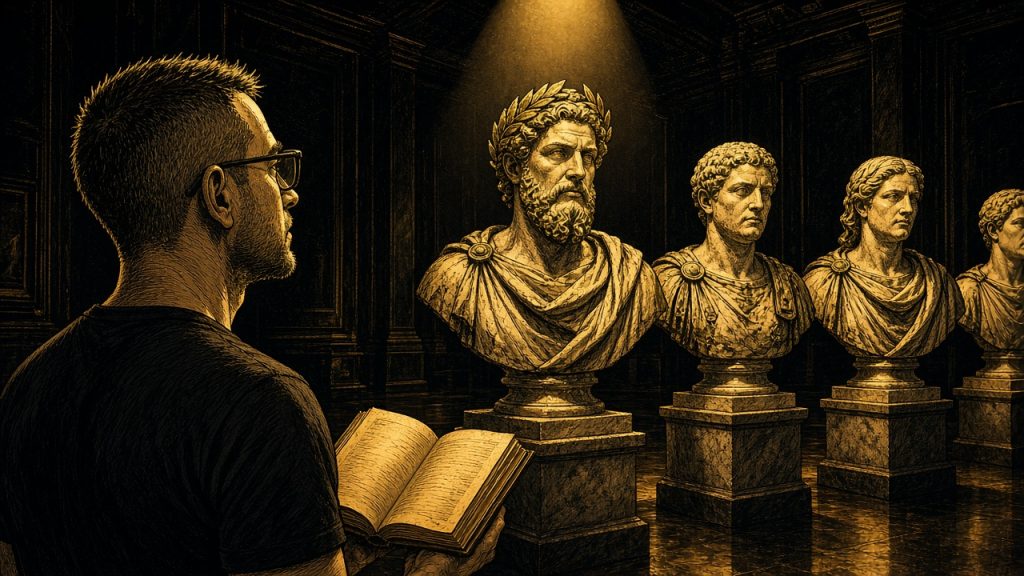
The lesson in plain language. In Chapter 6, Machiavelli advises a prudent man to follow the paths of great men and imitate those who were truly excellent, so that even if he doesn’t reach their level, some of it rubs off.
Chapter 14 makes training a duty. A ruler should never stop thinking about war, and in peacetime should prepare even more than in war, through action and through study. Machiavelli praises Philopoemen, a leader of the Achaean League, who even in peace walked the countryside with friends, discussing how they’d fight if an enemy appeared on that hill or in that valley. For study, a ruler should read history and examine the actions of great men: how they conducted themselves, why they won and lost. He notes that Alexander the Great imitated Achilles, Julius Caesar imitated Alexander, and Scipio imitated Cyrus.
Chapter 24 drives it home: Italian rulers who lost their states shouldn’t blame fortune but their own idleness. In calm times they never thought the weather would change.
At work. Find men who’ve done what you want to do, and study them: their books, interviews and decisions, and how they handled failure. Practise your skills when nothing’s at stake, so they’re ready when everything is.
In business. Read the history of your industry and of the businesses you admire. Run “Philopoemen walks”: regularly ask, “If a competitor did this, or the market shifted like that, how would we respond?”
In dating and relationships. Study good relationships, not just bad ones. Spend time with couples who’ve lasted, and ask how they handle conflict. Prepare in peace: the time to work on your temper, your communication and your self-respect is before the hard conversation, not during it.
In daily life. Read biographies. Choose two or three men whose lives you’d like to learn from, and keep them in mind when making decisions.
The ethical line. Studying great men is healthy, as long as you study them whole: their failures and cruelties as well as their wins. Imitating someone’s methods without their principles, or idolising a man rather than learning from him, is a trap.
Exercises.
- Choose one great man (historical or modern) whose path relates to yours. Read a biography of him this month, and write down three decisions he made that you’d like to learn from.
- Do a Philopoemen walk: take an hour, alone or with a friend, and work through three “what if” scenarios for your work or life, with your response to each.

Theme 9: Decide – Avoid Neutrality and Half-Measures
The lesson in plain language. In Chapter 21, Machiavelli says that nothing earns a ruler more esteem than great undertakings. His example is Ferdinand of Aragon, who began his reign by attacking Granada, which kept his nobles occupied and built his reputation, and then moved from one great enterprise to the next, so that people were always waiting to see what he’d do.
The same chapter makes a strong case against neutrality. When two powers near you are in conflict, it’s almost always better to declare yourself openly. If you stay neutral, the winner won’t want a friend who didn’t help him in his trouble, and the loser won’t shelter you because you didn’t share his fate. He cites the Romans warning the Achaeans against staying neutral in their war with Antiochus.
Throughout the book he warns against half-measures and indecision, which breed contempt. The final chapter, 26, is a passionate appeal to the Medici to seize the moment and free Italy from foreign armies. He argues that the time is right and that what’s missing is a leader with the will to act. He closes with lines from the poet Petrarch about Italian courage not yet being dead.
At work. When there’s a real choice to make, make it. Leaders are judged more harshly for drifting than for being wrong. Take on visible, meaningful projects rather than staying safely invisible. In real conflicts between colleagues, don’t always hide behind neutrality. Take the side you believe is right, respectfully and openly.
In business. Choose your market, your positioning and your direction, and commit. A business that tries to please everyone ends up known for nothing. Undertake one serious project a year that stretches you.
In dating and relationships. Indecision is unattractive and unkind. If you’re interested, say so. If you’re committed, act like it. If you know it’s over, say that too. Don’t leave a woman in years of “maybe.”
In daily life. Make small decisions fast. Save your deliberation for the few that matter, and then decide those too.
The ethical line. Decisiveness, commitment and courage are healthy. The corrupted form is starting fights or “great enterprises” just to look impressive, or forcing people to pick sides in conflicts that aren’t theirs. Decide for the right reasons, not for show.
Exercises.
- Write down the decision you’ve been avoiding longest. Set a date within the next seven days, gather what you need, and decide.
- Choose one “great undertaking” for the coming year: something meaningful, visible and a little beyond your comfort. Write the first step and take it this week.

What to Reject or Use with Caution in Relationships
Machiavelli wrote about states, armies and courts, where trust is scarce and betrayal can be fatal. A relationship with a partner, a close friend or family runs on the opposite principle. It only works if trust is built and kept. Here’s how I’d sort the book for the people you love.
Reject at the front door:
- Choosing fear over love. A partner should never be afraid of you. If fear is in the room, the relationship is already damaged.
- Breaking your word when it suits you. Machiavelli’s prince may break faith when necessary. A man in a relationship who does this destroys the one thing it rests on.
- Seeming good rather than being good. Keeping up appearances while acting otherwise is deception. She’ll see it eventually.
- Cruelty “well used.” There’s no such thing in love. Hard truths, yes, delivered kindly. Cruelty, never.
- The Borgia move. Getting someone else to do your dirty work, then blaming them. Own what you do.
- Ruling rather than partnering. A relationship isn’t a principality. She’s not your subject, and you’re not her prince.
Use with real caution:
- The fox. Useful for spotting manipulation and red flags, especially early. Corrosive if it turns into constant suspicion of someone who’s earned your trust.
- Thrift. Good as a guard against buying affection. Bad as stinginess with someone who shares your life.
- Advisors on your terms. Good for choosing honest friends. Wrong if it means your partner may only speak when invited.
- Avoiding neutrality. Good when it means being clear about your intentions. Bad if it means forcing friends to take sides.
Keep and use well:
- Virtù and fortuna. Build your own dykes: health, purpose, friends, stability. Then you bring strength into a relationship, not need.
- Your own arms. Have your own life. You’ll be chosen, not depended on.
- Avoid contempt. Be decisive, consistent and steady. Respect follows.
- Hard things at once. Say what needs saying, fully and kindly, rather than hinting for months.
- Keeping, not just acquiring. Stay present after the chase is over.
- Decisiveness. If you want her, say so. If you’re in, be in.
The SOVEREIGN principle sums it up: rule yourself, never her.

How to Use This: A 30-Day Practice and Checklists
A 30-day practice (one theme every few days)
Spend three days on each theme, then use the last three for review. Each morning, read the theme’s section and pick one exercise. Each evening, write three lines: Where did fortune act on me today? Where did I use my own virtù? Where did I rule myself well, and where did I hand that rule away?
| Days | Focus | Daily question |
|---|---|---|
| 1–3 | Virtù and fortuna | What dyke did I build today? |
| 4–6 | Your own arms | What did I rely on today that I don’t control? |
| 7–9 | Loved, respected, never despised | Did I hold my boundaries calmly today? |
| 10–12 | The fox and the lion | What trap did I spot, and where did I stand firm? |
| 13–15 | Hard things at once | What did I deliver cleanly, and what am I still dripping out? |
| 16–18 | Advisors and flatterers | Who told me the truth today, and did I listen? |
| 19–21 | Acquiring and keeping | What small problem did I fix before it grew? |
| 22–24 | Study great men | What did I learn from someone ahead of me? |
| 25–27 | Decide | What did I decide today instead of postponing? |
| 28–30 | Review | Which three lessons changed something, and what did I reject? |
If 30 days is too much, take one theme a week for nine weeks.
Self-audit checklist: how well am I ruling myself?
Tick any that are true for you right now.
- ☐ I have no real savings, skills or relationships to fall back on if fortune turns.
- ☐ My income, mood or sense of worth depends mostly on one person or source.
- ☐ People around me don’t know where my boundaries are.
- ☐ I change my mind often, and people have noticed.
- ☐ I’m either a pushover (no lion) or naive about traps (no fox).
- ☐ I deliver bad news in instalments instead of all at once.
- ☐ I spend to impress, or I’m stingy with the people who matter.
- ☐ I’m surrounded by people who mostly agree with me.
- ☐ I work hard to win things (jobs, clients, women) and then neglect them.
- ☐ I haven’t studied anyone who’s done what I want to do.
- ☐ I’ve been avoiding a major decision for months.
- ☐ I blame fortune for outcomes I could have prepared for.
Pick the two ticks that cost you most, and start there.
Spotting Machiavellian tactics used on you
You don’t have to use these tactics to need to recognise them. Watch for these patterns at work, in business and in love.
- ☐ A good front that doesn’t match the record. Words of loyalty, generosity or honesty, with actions that tell a different story. Judge by what they do.
- ☐ Promises that quietly expire. Agreements kept only while they’re convenient. Get important ones in writing.
- ☐ The scapegoat play. Someone else is made to do the unpleasant work, then blamed for it. Don’t volunteer to be the Remirro.
- ☐ Flattery from people who want something. Excessive praise just before a request. Ask what’s being bought.
- ☐ Borrowed strength offered as a gift. “Let me handle that for you” in a way that leaves you dependent. Keep your own arms.
- ☐ Divide and rule. Someone creating rivalry between you and colleagues, friends or family. Talk directly to the other party.
- ☐ Fear as a management tool. Unpredictable anger, threats or punishments used to keep you compliant. Document it, and plan your exit if needed.
- ☐ Benefits drip-fed, harms dumped at once. Small rewards dangled to keep you hoping while big costs land suddenly. Look at the total.
- ☐ Isolation from your advisors. Someone discouraging you from talking to friends, family or mentors. This is a serious warning sign.
If you see three or more of these from the same person, trust the pattern over the words.
Conclusion
The Prince was written by a man who had lost everything. His job, his status, his place in the city he loved, and very nearly his life. He sat in a farmhouse study in the evenings and tried to work out, as honestly as he could, how power really works. He didn’t flatter his readers, and he didn’t flatter human nature.
That’s why the book still matters. A man who doesn’t understand how power is won, kept and lost isn’t more virtuous for it. He’s just more exposed. Read Machiavelli and you’ll build your dykes before the flood, rely on your own arms, keep your boundaries, choose honest counsel, fix small problems early, study men greater than you, and decide when the moment comes.
Then draw your own lines. Use the lessons of self-rule freely. Use the lessons of leadership with care and the “would I be comfortable if they knew?” test. And leave the cold parts, the fear, the broken faith, the false front, at the door of every relationship you care about. The point of being sovereign isn’t to rule other people. It’s to rule yourself well enough that no one else has to.
Want more like this? I talk about mindset, masculinity, dating and relationships on my YouTube channel, HRH (@HRHProject). If this was useful, subscribe and come along for the next one.
Affiliate disclosure: Some links in this article are affiliate links. If you buy through them, I may earn a small commission at no extra cost to you. I only recommend things I'd use myself.
1 Comment